Real Estate / Japan Has 9 Million Empty Homes — and a Growing Market for Giving Them Away
Why a house listed at ¥0 can be a better deal for the seller than for the buyer, and the odd little industry that grew up around it.
Picture a real-estate listing where the price field says ¥0. Not ¥0 down. Not a typo. Zero.
On Japanese sites like Minna no 0-en Bukken ("Everyone's Zero-Yen Properties"), that is the whole point. Owners list houses and vacant lots for free, and whoever they pick can take the property over once the contract and registration are done. On this site, it is the giving side that pays; the recipient still takes on the ordinary costs of owning a property.
The supply side of this market is enormous. Japan's 2023 Housing and Land Survey counted 9.0 million vacant homes, 13.8% of the entire housing stock, both record highs. The number has roughly doubled over 30 years. And the category that matters most here — homes that aren't for rent, aren't for sale and aren't anyone's vacation place, they're just empty — reached 3.85 million, up from 3.49 million in 2018. Neither number counts houses on offer for ¥0: the 9.0 million includes homes for rent, homes for sale and second homes, and even the 3.85 million includes houses whose owners are only temporarily away or that are waiting to be demolished. What they show is how large the pool of unused houses is, not the supply of free listings.
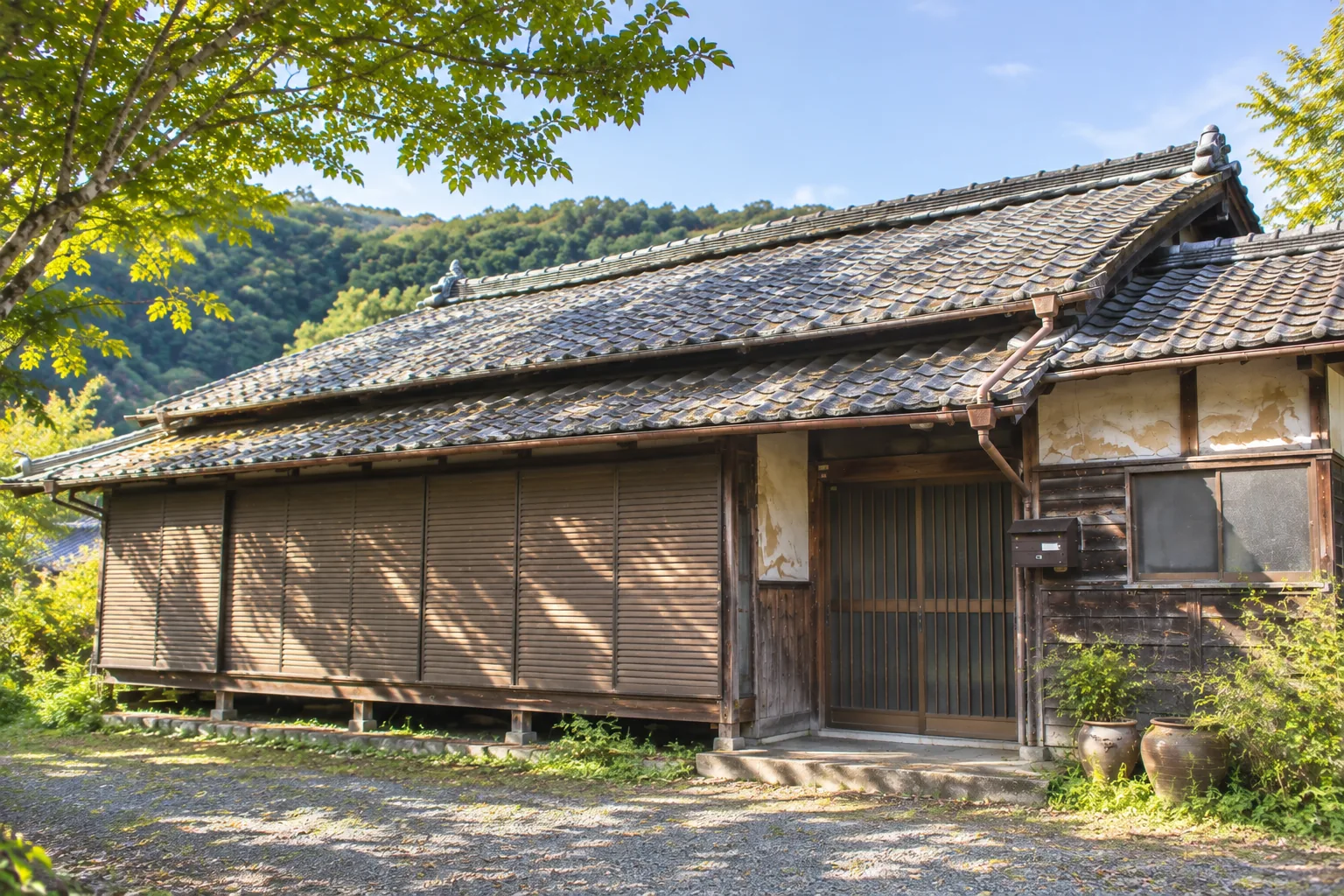
Not all of those houses are abandoned in any dramatic sense. One common way to end up with one, for example: a parent dies, the children live in a big city, and suddenly they own a house in a town they left decades ago, along with its property tax, its upkeep and its liability if the roof comes down in a typhoon.
Minna no 0-en Bukken, run by a small company in Asahikawa, Hokkaido, has been matching these reluctant owners with takers since July 2019. By early 2021, the most recent figure we found in our searches before publication, it had listed 160+ properties, and about 80% of them had found someone. Asahikawa Shinkin Bank said it planned to hand the site's flyers to customers inheriting property they had no use for, and Obihiro Shinkin Bank signed a formal partnership with the operator on 28 January 2022. The national government has paid attention too: a model project backed by the Ministry of Land, Infrastructure, Transport and Tourism used the company to work through the legal and tax kinks of free transfers.
Free doesn't mean unwanted, either. The "free old farmhouse" has become its own genre: in October 2025 a 113-year-old wooden house in Yunomae, Kumamoto, was offered at zero. Applicants had to view it in person and submit a business plan, and the owner picks who gets it.
So why does a country with a functioning real-estate industry need a separate marketplace for houses that cost nothing? The answer is a nice little lesson in incentives.
Why brokers won't touch a ¥100,000 house
In Japan, a broker's fee is capped by regulation as a percentage of the sale price. Until July 2024, the cap meant that on a ¥100,000 (about $637) property, a broker could collect at most 5% from the buyer, or ¥5,000 (about $32) plus consumption tax. Viewings, title checks, the legally required explanation of material facts, the contract — all for about ¥5,000. Unsurprisingly, many brokers didn't bother, and cheap rural property circulated poorly.
The government tried to fix this. Since July 2024, on properties priced at ¥8 million (about $51,000) or less, a broker can charge a buyer up to ¥330,000 (about $2,100) including tax, as long as the costs justify it and the buyer agrees in advance. But as housing writer Yusuke Yoshikawa points out, bolting a ¥330,000 fee onto a house nobody would buy for ¥100,000 doesn't make it sell. It just makes the gap between "real estate" and "this thing my late uncle owned" more explicit. The result is a parallel channel for low-value houses, where many deals happen without a broker.
The seller is the real customer
The counterintuitive part: in a ¥0 transaction, the person getting the better deal can be the one giving the house away. Obihiro Shinkin Bank describes the benefit to owners plainly: they're released from the ongoing burden of taxes, utilities and upkeep. Japanese has a pun for this kind of asset, fu-dōsan — the word for real estate with the first character swapped for "negative."
Once you see the seller as the customer, the market makes sense, and it has already layered up:
- Matching sites like Minna no 0-en Bukken connect givers and takers directly. Recipients pay the site nothing; the giving side pays. As of 2021, owners could list for free with no support, or choose a full-support plan that charged them ¥150,000 (about $956) (before tax) once the transfer went through. Current pricing may differ.
- Paid takeover. The newest layer goes past zero. Writing in 2025, Yoshikawa said services where the owner pays someone to take the property had expanded rapidly over the previous two to three years. When a ¥0 price still can't clear the market, the price simply goes negative.
- Heritage projects. The kominka (old farmhouse) scheme behind the Kumamoto listing pairs free transfers with a mission to keep old buildings alive. It is still tiny: the Kumamoto case was described as one of only about five nationwide.
The catch
For the person taking the house, the catch is everything that isn't the purchase price. Many of these are direct transfers between the two parties, and when no licensed broker is involved, the legally required explanation of material facts may never happen. In our view, that's the real risk: roofs, plumbing and earthquake retrofits can cost far more than the price you saved, so a taker needs to check the house, and the contract, with the same care as any purchase.
That's why the most interesting players in this market aren't selling houses at all. They are selling trust and process — screening, paperwork, introductions, local-government relationships — around an asset whose price has already hit zero.
Japan isn't the only country trying to get empty houses back into use. Italy and Ireland have tried very different fixes. How do they compare, and what would it actually take for a foreigner to take on a Japanese akiya? That's the members' edition.
Could This Work in the U.S.?
Ask anyone who has inherited a house in a town they left: what would they pay to hand it on to someone who wants it? Is there room in the US for a marketplace where the seller is the paying customer? What would you charge — and to whom?
What's in the members' edition
The story above is complete on its own. When memberships open, members will also get, by email: three ways to move an empty house
- Italy: sell it cheap, but make the buyer renovate
- Ireland: pay the owner to fix it
- Japan: let the owner pay to leave
- What the comparison shows
Sold separately, a premium brief: taking on a Japanese akiya from abroad
- "Free" still has costs
- New paperwork in 2026
- The risks the price hides
- Worksheet: your own numbers
- Next step
Company links
Links to the companies' own sites and to stock quotes. We have no business relationship with them.
- Minna no 0-en Bukken — Official site
Dollar figures are approximate: yen converted at ¥156.87 = $1 (Federal Reserve H.10 (noon buying rate in New York, via FRED DEXJPUS), 2026-10-23). This is the rate on that date, not the rate at the time of each figure.
Sources
S1. 2023 Housing and Land Survey — Summary of Results (Housing and Households) — Statistics Bureau of Japan, 2024-09 S2. Final count of vacant homes: 9.002 million — StepOn (Mitsui Sumitomo Trust Realty) real-estate news, 2024-09-27 S3. Partnership agreement with 0-en Toshi Kaihatsu LLC on vacant-property circulation — Obihiro Shinkin Bank, 2022-01-31 S4. Asahikawa Shinkin Bank's vacant-home initiative: Minna no 0-en Bukken — Shinkin Central Bank Research Institute, 2021-03-09 S5. Model project report: issues and methods in zero-yen (free transfer) vacant-home transactions — Ministry of Land, Infrastructure, Transport and Tourism (MLIT) S6. Why zero-yen properties still don't sell after the brokerage-fee reform — ITmedia Nlab (Yusuke Yoshikawa), 2025 S8. '0-yen kominka project' launches in Kumamoto — KAB Kumamoto Asahi Broadcasting, 2025-10-27 S12. Excerpt from 'Bubble Resorts Today' — zero-yen properties in Naeba — Gentosha Gold Online (Yusuke Yoshikawa) S13. Brokerage fee rules for low-priced vacant homes (revised July 2024) — Ministry of Land, Infrastructure, Transport and Tourism (MLIT) A1. This Italian town is selling homes for $1 (Sambuca, Sicily) — CNN Travel A2. Vacant Property Refurbishment Grant — Limerick City and County Council A3. Fixed asset tax (overview) — Ministry of Internal Affairs and Communications A4. Gift tax basic exemption (Tax Answer No. 4402) — National Tax Agency A5. Registration and license tax rates for land and buildings (Tax Answer No. 7191) — National Tax Agency A6. Real estate acquisition tax (local tax system) — Ministry of Internal Affairs and Communications A7. Reporting system for acquisitions of real estate in Japan by non-residents — Ministry of Finance A8. Leaflet: reporting acquisitions of real estate in Japan by non-residents (from 1 April 2026) — Ministry of Finance A10. Mandatory nationality information in real-estate registration: requirements from October 2026 — Fudosan Meigi Henko Tetsuzuki Center (judicial scrivener corporation), 2026-10-22 A9. Circular on handling real estate registration after the amended registration rules (nationality information) — Ministry of Justice, 2026-09-04